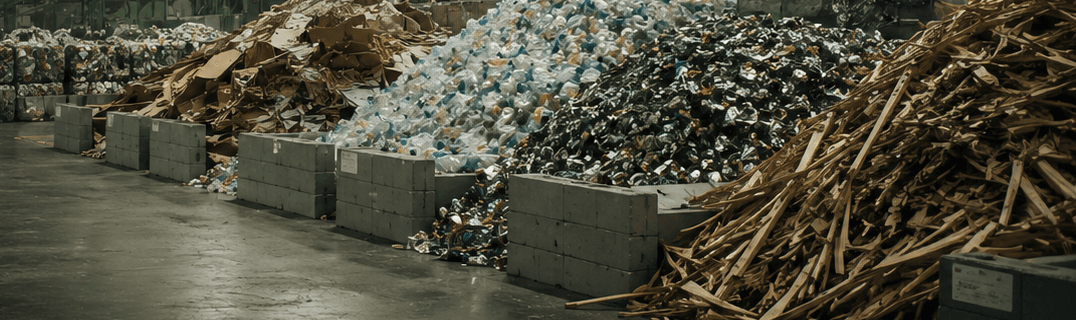
Wood (A, B, C)
From untreated solid wood to contaminated wood. Three classes, three recovery channels.
Wood is one of the largest streams we handle. It is classified into three categories according to its level of treatment and contamination, each directed to a dedicated channel.
Recycling into particle board for clean wood, energy recovery for treated or contaminated wood.
Plastic
Derived from petroleum (naphtha), plastic is divided into 7 main families according to the industry classification.
Plastic is mainly derived from petroleum, more precisely from naphtha, which is converted by cracking and then polymerisation into polymers shaped by moulding, injection or thermoforming.
There are 7 main families, according to the classification established by the Society of the Plastics Industry. This classification, still little known outside the recycling world, determines which channel each plastic is sent to.
Compacted into bales, then recycled by plastics processors into secondary raw materials for new packaging.
Glass
Flat glass (glazing, windscreens, mirrors) and container glass (bottles, jars). Infinitely recyclable.
The glass family includes soda-lime flat glass (double glazing, laminated glass, windscreens, windows, mirrors) and container glass (bottles, jars).
Glass can be recycled indefinitely, provided it is clean, free of impurities and properly sorted by type. Some non-fusible glasses (glass ceramic, lead crystal, borosilicate such as Pyrex) remain difficult to recycle.
Recycled into panes, bottles and glass wool. Considerable savings in sand, lime, soda ash and CO2.
Paper and cardboard
Among the most recycled materials: packaging boxes, newspapers, magazines, office paper.
Paper and cardboard are among the most recycled materials. Recovering them saves resources and energy: packaging boxes, newspapers, magazines, leaflets, office paper, as well as photo paper and kraft envelopes.
Once recycled at paper mills, they become recycled cellulose fibres, used to produce cardboard, kitchen roll, newsprint or writing paper.
Recycled at paper mills into recycled cellulose fibres.
Metals
Ferrous metals (iron, steels, cast irons) and non-ferrous metals (lead, zinc, tin, chromium, precious metals).
Ferrous metals (iron, steels, cast irons) are widely used in building structures and infrastructure. Despite their susceptibility to corrosion, they can be recovered and recycled to reduce the extraction of new resources.
Non-ferrous metals (copper, aluminium, stainless steel, brass, bronze, lead, zinc, tin) are also recycled to prevent their depletion and reduce the impact of their extraction.
Recycling that avoids extracting new resources and protects ecosystems.
Insulation materials
Mineral wool, EPS/XPS, wood fibre, cellulose wadding, cellular glass. Recyclability varies.
Recycling insulation is a sustainability issue in construction. Mineral wools (glass, rock, ceramic) are difficult to recycle, but clean production offcuts can be reintroduced.
EPS and XPS (polystyrene) can be turned into recycled granules. Wood fibre, cellulose wadding (made from recycled paper) and cellular glass (Foamglas) can also be recovered.
Recycling of clean offcuts and certain insulation materials (XPS, cellulose, wood fibre, Foamglas). Mineral wools are difficult to recycle.
Bituminous and tar products
Asphalt mixes, waterproofing and liquid bitumens. Hazardous above a PAH threshold.
Bituminous products (asphalt mixes, waterproofing or liquid bitumens) are considered hazardous when the concentration of polycyclic aromatic hydrocarbons (PAHs) exceeds a certain threshold.
Energy recovery is preferred for these materials, converting them into energy while minimising environmental risks. Non-hazardous liquid bitumens can be recycled.
Energy recovery preferred; recycling possible for non-hazardous liquid bitumens.
Mixed waste
Waste delivered mixed: packaging, construction/demolition, bulky waste. Mechanical and manual sorting.
This category covers all waste delivered mixed: assorted packaging, construction and demolition waste, bulky waste (mattresses, sofas, furniture). It is highly heterogeneous.
This waste often results from a lack of storage space on sites. Mechanical and then manual sorting is carried out at our facility to best separate the fractions intended for reuse and recycling.
Mechanical and manual sorting to separate the fractions intended for reuse and recycling.
Rubber and tyres
Tyres and rubber recovered as granules, in steelworks or as substitute fuel.
Recovering rubber and tyres, through recycling or thermal conversion, plays an essential role in sustainable resource management.
Recycling produces granules, material for steelworks or foundries, or shredded rubber. Energy recovery converts this waste into energy, particularly in cement works or as a substitute fuel.
Recycling (granules, shreds, steelworks) or energy recovery (cement works, substitute fuel).
Inert waste (rubble)
Stone, concrete, sand, soil, plaster, aerated concrete (Ytong). Crushed and reused.
Inert waste (stone, concrete, sand, soil, plaster, aerated concrete) is often recovered from demolition or construction sites, then sorted and processed for reuse or conversion.
Crushing, screening and recycling that reduce construction waste and save natural resources.
Hazardous waste
Acids, bases, detergents, fuels, solvents, paints, inks. Specific handling and treatment.
Recycling special and hazardous waste (acids, bases, detergents, fuels, solvents, paints, inks) is essential for protecting the environment and public safety. These materials require specific handling.
Treatment involves specialised processes: neutralising acids and bases, recovering solvents and fuels, recycling containers. Final residual waste is sent for energy recovery.
Neutralisation, recovery and container recycling; final residual waste sent for energy recovery.
Waste electrical and electronic equipment
Refrigeration appliances, household appliances, light bulbs, fluorescent tubes.
Recycling waste electrical and electronic equipment is vital. It includes refrigeration appliances, large and small household appliances, batteries, light bulbs and fluorescent tubes.
These items contain harmful substances (mercury, lead, greenhouse gases). Recycling them recovers valuable materials and prevents pollution. They are consolidated safely, in compliance with standards.
Secure consolidation, recovery of valuable materials and treatment of harmful substances.
Green waste
Branches and stumps from pruning and trimming. Shredded into compost or chips.
Recycling green waste (branches and stumps from pruning and trimming) is essential for the sustainable management of organic waste.
Branches are shredded into compost or wood chips, used as mulch to protect and fertilise the soil. Stumps are shredded and turned into mulch or organic compost.
Shredded into compost, mulch or wood chips for agricultural and horticultural use.
Textiles
Clothing and floor coverings. Reuse (donations, second-hand) or conversion into new products.
Recycling textiles (clothing, floor coverings) reduces waste and promotes the circular economy. Used clothing is collected, sorted and recycled in various ways.
Some items are reused as they are through donations or second-hand sales, others are turned into new textile products or insulation materials. Rugs and carpets are recycled into fibres.
Reuse through donations and second-hand, or recycling into textile fibres and insulation materials.
Asbestos-containing waste
Carcinogenic material. Bonded (fibre cement) and non-bonded (friable) asbestos. Regulated handling.
Widely used in the past for its strength and insulating properties, asbestos is a carcinogenic substance that is dangerous when inhaled. Asbestos waste is classified according to its level of hazard.
Unfortunately, there is currently no recycling solution for this material in the Greater Region. It is sent to disposal channels such as controlled landfill.
Secure packaging and transport to a specialised facility for disposal by controlled landfill.
Batteries
Hazardous waste containing metals and chemical substances. Vehicle and industrial batteries and accumulators. Regulated collection and treatment.
Batteries and accumulators contain various metals and chemical components that can pose risks to the environment and health if they are not handled properly.
After collection, batteries are sorted and sent to specialised channels. They are treated to recover and recycle the recoverable materials, in particular metals, while hazardous components are handled under suitable, safe conditions.
Treatment through specialised channels: recovery and recycling of metals and recoverable materials, with safe handling of hazardous components.
Residual waste
Collected from your premises, turned directly into energy.
Residual waste is the non-recyclable fraction of your activity: everyday waste bags, soiled packaging, composite items, sweepings. ECOTEC provides wheelie bins, plastic bins or compactors, collects directly from your site and takes this waste, without passing through our centre, to an incineration plant with energy recovery.
Residual waste does not pass through our sorting centre: it is collected from your premises and delivered directly to an approved incineration plant, where the recovered energy produces electricity and heat. The smaller your residual share, the lower your bill: sorting cardboard, wood, metals and plastics at source reduces the most expensive tonnage to treat.